Real progress begins long before equipment arrives on a project site, and the surveys completed beforehand shape almost every decision that follows. Site-survey work carried out for international construction demands accuracy, context, and careful interpretation. These methods give teams the technical clarity needed to build safely and responsibly across diverse global environments.
Boundary Surveys to Establish Legal Property Lines and Corners
Boundary surveys confirm the exact limits of a site by identifying deed calls, markers, and legally recognized points. These surveys prevent future disputes and ensure that construction occurs only within permitted perimeters. Navigator International Global Construction depends on strict legal accuracy because international work often involves overlapping land records or varying national standards.
Survey teams analyze plats, historical records, and regional benchmarks to verify that the corners and lines represented on paper match the land itself. This step safeguards structure placement and helps avoid conflicts with nearby landowners, especially where legal descriptions are decades old or poorly documented.
Topographic Surveys Mapping Natural and Man-made Features, Including Elevations and Contours
Topographic surveys document everything physically present on the terrain—ridges, slopes, vegetation, buildings, drainage paths, and more. These maps help engineers understand how the land behaves and what must be modified or protected. For global sites, this becomes even more significant because climates and terrains vary widely.
Contours reveal slope behavior that influences drainage, access routes, and cut-and-fill calculations. These mapped elevations give construction planners a snapshot of how the land will respond once work begins, allowing the Navigator International Construction Company team to design workable layouts in both remote and urban settings.
Utility Surveys Using Ground-penetrating Radar to Locate Subsurface Pipes, Cables, and Voids
Utility surveys identify hidden infrastructure beneath the soil that could interfere with excavation or structural placement. Ground-penetrating radar detects non-metal and metal utilities, groundwater pockets, and voids without disturbing the site. This reduces risk and prevents environmental or service disruptions.
Maps from these surveys give engineers the ability to plan trenching, foundations, and utility tie-ins with fewer surprises. In regions where records are outdated or unavailable, this method becomes essential for accurate planning carried out by Nav Int construction personnel.
Geotechnical Surveys to Assess Soil Conditions and Stability for Foundation Design
Geotechnical surveys evaluate soil layers, density, moisture, bearing capacity, and potential contaminants. These tests show whether the ground can support heavy structures or whether specialized foundations are needed. International work often involves soil types unfamiliar to local crews, so detailed assessment prevents settlement and structural issues.
Field borings, lab testing, and on-site sampling offer a measured understanding of what lies below the surface. This data informs engineering teams on slope reinforcement, compaction requirements, and soil treatment strategies necessary for safe construction planning by Navigator International.
GPS and GNSS Surveying for Highly Accurate Geodetic Positioning Across Vast Areas
GPS and GNSS systems provide global positioning that aligns site features with national or international spatial grids. These tools enable rapid, high-accuracy measurements even across large or remote areas. For worldwide operations, this method supports the consistency required for complex construction planning.
Survey teams use satellites to capture horizontal and vertical data points with minimal human error. This seamless positioning helps create reliable basemaps and coordinates that support multi-phase work under the Navigator International Government construction program.
UAV and Photogrammetry Using Drones to Capture Aerial Images for Detailed 3D Modeling
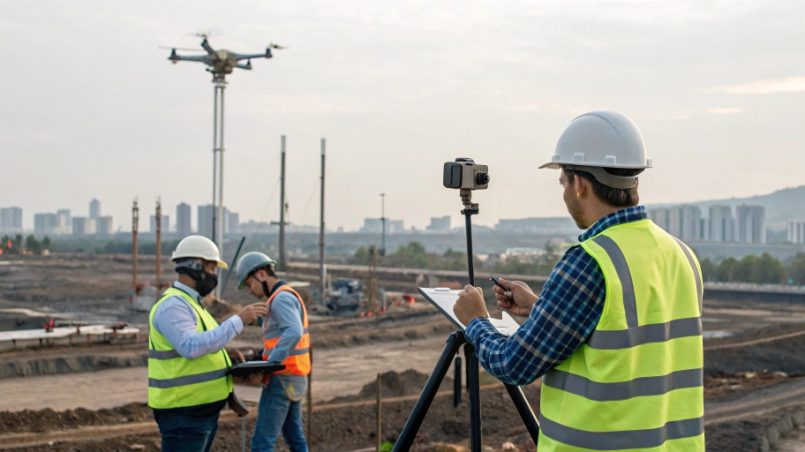
Drones equipped for photogrammetry capture hundreds or thousands of overlapping images from above. Software converts these images into detailed 3D models that display site shape, grade changes, vegetation, and surface obstacles. This method provides fast, accurate coverage across terrain that is difficult or unsafe to reach on foot.
The aerial perspective also helps identify drainage routes, equipment access challenges, and structural layout options. Compared to traditional ground methods, UAV surveys produce more complete visual information that enhances planning accuracy for international construction teams.
LiDar Surveying Using Laser Pulses to Generate Detailed 3D Terrain Models, Especially in Rugged Terrain
LiDar emits laser pulses that measure the distance between the sensor and the ground, generating dense point-cloud data. These points form an exact 3D representation of the terrain, even through light vegetation. This technique is particularly useful for rugged regions where shadows, steep slopes, or canopy cover would distort traditional surveys.
The precision of LiDar makes planning more reliable, especially for roadwork, large site grading, and infrastructure development. Laser-based modeling reveals subtle terrain changes that influence water flow, stability, and design decisions required for remote construction projects managed by Nav Int.
Environmental Surveys to Assess Site Conditions and Potential Impact on Ecology and Resources
Environmental surveys evaluate vegetation, water sources, wildlife habitats, and ecological sensitivities within a site. These studies help determine how construction should proceed while minimizing disruption to natural systems. International projects often involve diverse ecosystems, making accurate environmental reporting a key requirement.
Teams may assess erosion risks, protected species, flood tendencies, or contamination concerns. This information supports responsible construction planning, ensuring that work is carried out with respect for local environmental regulations and long-term sustainability goals. Those needing comprehensive survey capabilities supported by global construction expertise can rely on Navigator International to manage this level of site assessment with accuracy and consistency.